01: Introduction
Imagine you have two sorted lists of numbers and you want to combine them into one big sorted list. Sounds easy, right? The standard way is to use a third array to store the merged result. But what if you’re not allowed to use that extra memory?
That’s exactly the problem — merge two sorted arrays without extra space in Python. This forces you to work directly inside the original arrays, making it a great test of your understanding of in-place algorithms.
This problem shows up in top company interviews at Amazon, Google, Microsoft, and others because it tests memory awareness — a skill every real-world programmer needs. In embedded systems, mobile apps, or any low-memory environment, allocating extra arrays can be expensive or simply impossible.
02: Problem Statement
Given two sorted arrays arr1 of size n and arr2 of size m, merge them in sorted order such that arr1 holds the first n smallest elements and arr2 holds the remaining m elements. You cannot use any extra space.
Example 1
Example
Input:  arr1 = [1, 3, 5]   arr2 = [2, 4, 6]
Output: arr1 = [1, 2, 3]   arr2 = [4, 5, 6]
Example 2
Example
Input:  arr1 = [10, 12]   arr2 = [5, 18, 20]
Output: arr1 = [5, 10]    arr2 = [12, 18, 20]
Input Format
- First line: size of arr1 (n)
- Second line: n space-separated integers (arr1)
- Third line: size of arr2 (m)
- Fourth line: m space-separated integers (arr2)
Output Format
Print both arrays separated by a newline after merging.
Constraints
| Parameter | Value |
|---|---|
| 1 ≤ n, m ≤ 105 | Array size |
| 0 ≤ arr[i] ≤ 109 | Element range |
| Both arrays are sorted in ascending order | — |
| No extra space allowed | O(1) space |
03: Why This Problem Is Important
- Memory optimization — critical in embedded and IoT devices where RAM is limited
- Real-time systems — no time to allocate and free memory dynamically
- Database engines — merge operations on sorted runs during external sort
- Interview filter — companies use this to check if you understand space complexity
- Competitive programming — frequently appears in array/sorting problem sets
04: Naive Approach – Using Extra Space
The simple solution everyone thinks of first: merge both arrays into a third array, sort it (it’s already sorted so you just merge), then copy the first n elements back to arr1 and the remaining m elements to arr2.
naive_approach.py
# Naive: merge into extra array, copy back
def merge_naive(arr1, arr2):
    n, m = len(arr1), len(arr2)
    temp = []
    i = j = 0
    while i < n and j < m:
        if arr1[i] <= arr2[j]: temp.append(arr1[i]); i += 1
        else: temp.append(arr2[j]); j += 1
    temp += arr1[i:] + arr2[j:]
    arr1[:] = temp[:n]
    arr2[:] = temp[n:]
Time: O(n+m) | Space: O(n+m) — it creates an extra array of size n+m. This violates the constraint.
Optimal Approach 1 – Gap Method (Shell Sort Idea)
This is the best approach. It comes from the idea behind Shell Sort. Instead of comparing adjacent elements, you compare elements that are far apart — at a “gap” distance — and swap them if they’re out of order. The gap keeps shrinking until it becomes 1.
The key insight: treat both arrays as one logical array of size n+m. Compare elements at positions i and i + gap. If the element at the higher index is smaller, swap them. Reduce the gap and repeat.
gap = ⌈(n + m) / 2⌉ (ceiling division)
After each pass: gap = ⌈gap / 2⌉ Continue until gap = 0
Optimal Approach 2 – Swap and Sort Method
A simpler (but slightly less efficient) approach: compare the last element of arr1 with the first element of arr2. If arr1[n-1] > arr2[0], swap them. Then sort both arrays individually.
Pros: Easy to implement, intuitive logic.
Cons: After swapping, you need to re-sort each array — this adds O(n log n + m log m) time. Not interview-optimal.
05: Flowchart
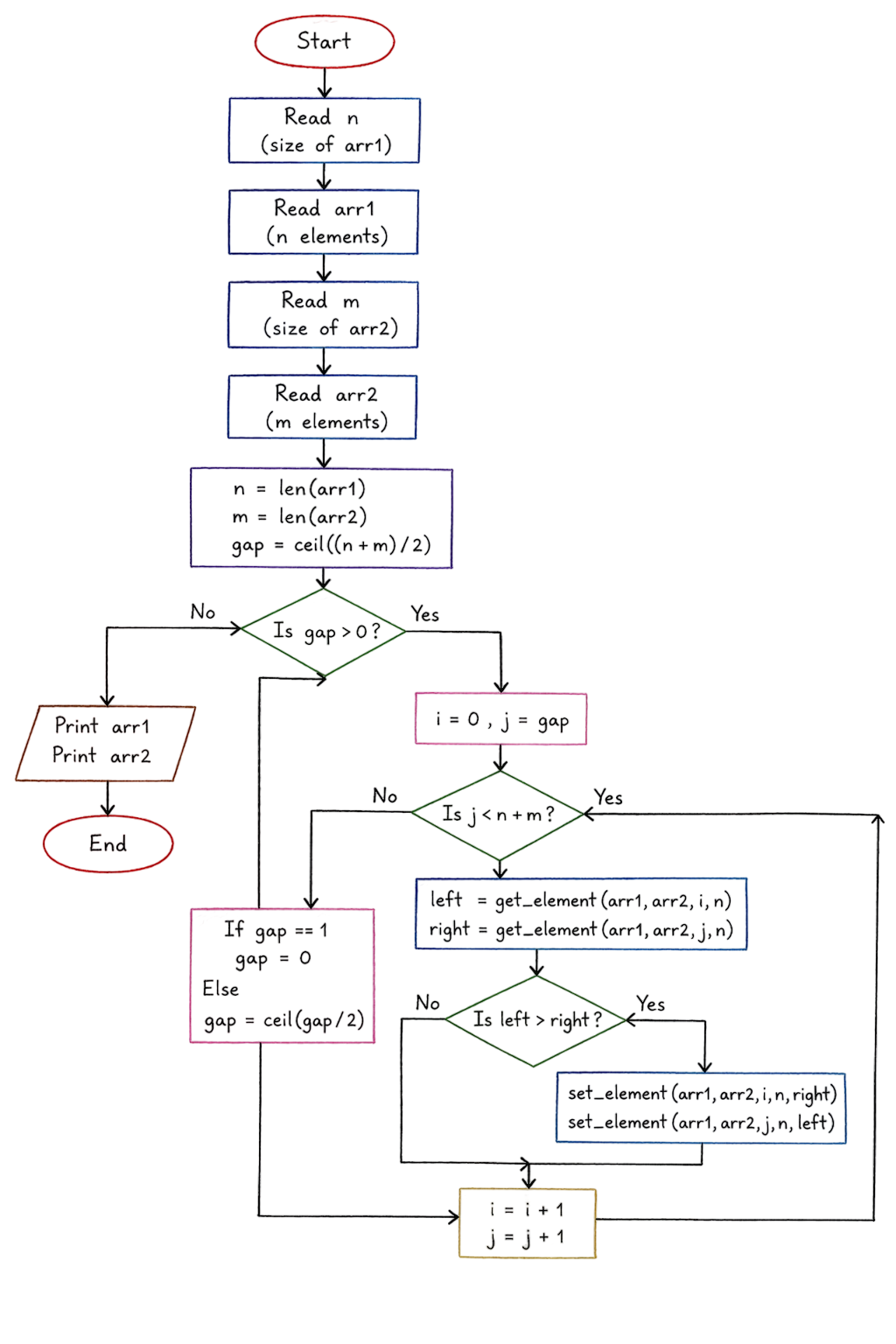
06: Pseudocode – Gap Method
FUNCTION merge_without_space(arr1, arr2):
    n = length of arr1
    m = length of arr2
    gap = ceil((n + m) / 2)

    WHILE gap > 0:
        i = 0
        j = gap

        WHILE j < n + m: IF i is in arr1 AND j is in arr2: compare arr1[i] with arr2[j - n] ELSE IF both i and j in arr2: compare arr2[i - n] with arr2[j - n] ELSE: compare arr1[i] with arr1[j] IF left element > right element:
                SWAP them

            i = i + 1
            j = j + 1

        IF gap == 1:
            gap = 0
        ELSE:
            gap = ceil(gap / 2)

    RETURN arr1, arr2
07: Python Program
import math

def get_element(arr1, arr2, index, n):
    # Treat arr1 + arr2 as one logical array
    if index < n:
        return arr1[index]
    return arr2[index - n]

def set_element(arr1, arr2, index, n, value):
    if index < n:
        arr1[index] = value
    else:
        arr2[index - n] = value

def merge_without_space(arr1, arr2):
    n = len(arr1)
    m = len(arr2)

    # Start with gap = ceil((n+m) / 2)
    gap = math.ceil((n + m) / 2)

    while gap > 0:
        i, j = 0, gap

        while j < n + m:
            left  = get_element(arr1, arr2, i, n)
            right = get_element(arr1, arr2, j, n)

            # If left element is greater, swap them
            if left > right:
                set_element(arr1, arr2, i, n, right)
                set_element(arr1, arr2, j, n, left)

            i += 1
            j += 1

        # Reduce gap; stop when gap becomes 0
        if gap == 1:
            gap = 0
        else:
            gap = math.ceil(gap / 2)


n = int(input("Enter size of arr1: "))
arr1 = list(map(int, input("Enter arr1 elements: ").split()))

m = int(input("Enter size of arr2: "))
arr2 = list(map(int, input("Enter arr2 elements: ").split()))

merge_without_space(arr1, arr2)

print("arr1:", arr1)
print("arr2:", arr2)
09: Dry Run – Step by Step
Let’s trace through with arr1 = [1, 3, 5], arr2 = [2, 4, 6]. Combined logical array: [1, 3, 5 | 2, 4, 6], n=3, m=3, total=6.
Compare index 0↔3: arr1[0]=1 vs arr2[0]=2 → 1<2 → no swap
Compare index 1↔4: arr1[1]=3 vs arr2[1]=4 → 3<4 → no swap
Compare index 2↔5: arr1[2]=5 vs arr2[2]=6 → 5<6 → no swap
State: [1, 3, 5 | 2, 4, 6]
Compare 0↔2: 1 vs 5 → no swap
Compare 1↔3: 3 vs 2 → swap! → [1, 2, 5 | 3, 4, 6]
Compare 2↔4: 5 vs 4 → swap! → [1, 2, 4 | 3, 5, 6]
Compare 3↔5: 3 vs 6 → no swap
State: [1, 2, 4 | 3, 5, 6]
Compare 0↔1: 1 vs 2 → no swap
Compare 1↔2: 2 vs 4 → no swap
Compare 2↔3: 4 vs 3 → swap! → [1, 2, 3 | 4, 5, 6]
Compare 3↔4: 4 vs 5 → no swap
Compare 4↔5: 5 vs 6 → no swap
State: [1, 2, 3 | 4, 5, 6]
arr1 = [1, 2, 3] arr2 = [4, 5, 6]
10: Time & Space Complexity
| Approach | Time | Space | Verdict |
|---|---|---|---|
| Naive (extra array) | O(n+m) | O(n+m) | ❌ Violates constraint |
| Swap + Sort | O(n log n + m log m) | O(1) | ⚠ Acceptable but not optimal |
| Gap Method | O((n+m) log(n+m)) | O(1) | ✅ Best for interviews |
11: Test Cases
| # | arr1 | arr2 | Expected arr1 | Expected arr2 | Case Type |
|---|---|---|---|---|---|
| 1 | [1, 3, 5] | [2, 4, 6] | [1, 2, 3] | [4, 5, 6] | Normal |
| 2 | [1, 2, 3] | [4, 5, 6] | [1, 2, 3] | [4, 5, 6] | Already sorted |
| 3 | [1, 2, 3] | [7, 8, 9] | [1, 2, 3] | [7, 8, 9] | All arr1 < arr2 |
| 4 | [] | [1, 2, 3] | [] | [1, 2, 3] | Empty arr1 |
| 5 | [1, 1, 2] | [1, 2, 3] | [1, 1, 1] | [2, 2, 3] | Duplicates |
| 6 | [108, 109] | [5, 107] | [5, 107] | [108, 109] | Large values |
12: Edge Cases to Watch For
- Empty array — if either array is empty, the other stays unchanged. Your loop simply won’t execute meaningful swaps.
- Single element — gap starts at 1, one comparison happens. Works correctly.
- All same elements — comparisons never trigger swaps. Final result is unchanged and already correct.
- Reverse sorted inputs — the gap method handles this since it doesn’t rely on input order assumptions.
13: Mistakes Beginners Make
- Using an extra array — this solves nothing and fails the constraint
- Wrong ceiling division — using
gap // 2instead ofmath.ceil(gap / 2)breaks the algorithm - Off-by-one in index mapping — forgetting that arr2 starts at index
nin the logical array - Not handling the gap=1 case — leads to an infinite loop if gap never reaches 0
- Comparing across wrong boundaries — always check which array index
iandjbelong to
14: Common Interview Questions
It borrows from Shell Sort. By comparing elements far apart and moving them closer over multiple passes, it eliminates inversions (out-of-order pairs) progressively. When gap finally reaches 1, it’s essentially a bubble sort pass — but by then, very few inversions remain.
No. The theoretical lower bound for in-place merging is O((n+m) log(n+m)). Achieving O(n+m) in-place requires complex linked-list tricks that aren’t practical in interview settings.
The gap method. It’s O(1) space, reasonably optimal time, and demonstrates knowledge of both the Shell Sort concept and in-place manipulation — exactly what interviewers want to see.
Yes. It’s a well-known problem on GFG and LeetCode (LC #88 variant). Companies like Samsung, Wipro, TCS, and mid-level product companies ask this specifically to test space complexity awareness.
In embedded systems, IoT firmware, and real-time operating systems, heap allocation is either unavailable or too slow. Writing in-place algorithms is a survival skill in those environments.
15: Real World Uses
- Database engines — sorting and merging sorted runs during merge-sort external sorting
- File systems — merging sorted index blocks without loading them entirely into RAM
- Streaming data — combining two sorted event streams in real-time pipelines
- Compiler symbol tables — merging sorted symbol lists during linking
- Memory-constrained IoT devices — microcontrollers with kilobytes of RAM
16: FAQ
Conclusion
Merging two sorted arrays without extra space is one of those problems that looks simple at first but teaches you something deep — that memory isn’t free, and good engineers respect it.
The gap method is your go-to approach: O(1) space, clean implementation, and grounded in a real sorting algorithm concept. Master this, and you’ll handle any in-place array problem in interviews with confidence.
Practice it a few times with different inputs, trace through the dry run manually, and you’ll never forget how it works.
Suggested Reading
- Two Sum Problem in Python – Hash Map Approach
- Binary Search Explained – Every Variant You Need
- Array Rotation Problems – Reverse Method & Juggling
- Largest & Smallest Element in an Array – O(n) Guide