01: Introduction
That algorithm is called the Boyer-Moore Voting Algorithm, and once you understand how it works, it becomes one of those patterns you never forget. This guide walks you through every approach — from brute force to the optimal solution — step by step, with a dry run, Python code, and everything you’d need to confidently explain this in an interview.
Sorting the array first, then checking the middle element — this works but costs O(n log n). The Boyer-Moore approach is faster and doesn’t need sorting at all.
02: Problem Statement
Given an array of integers nums of size n, find the element that appears more than n/2 times. This element is called the majority element. You may assume that the majority element always exists in the array.
Example 1
Input: nums = [3, 2, 3]
Output: 3
Why: Array size is 3. Element 3 appears 2 times. 2 > 3/2 = 1.5 ✓
Example 2
Input: nums = [2, 2, 1, 1, 1, 2, 2]
Output: 2
Why: Array size is 7. Element 2 appears 4 times. 4 > 7/2 = 3.5 ✓
03: Input / Output Format
- First line: integer
n— size of array - Second line:
nspace-separated integers
- A single integer — the majority element
- If none exists: print
-1(for extended version)
04: Constraints
1 ≤ n ≤ 5 × 10⁴-10⁹ ≤ nums[i] ≤ 10⁹- The majority element is guaranteed to exist in the array
LeetCode Problem 169 uses these exact constraints. Aim for O(n) time and O(1) space as a follow-up challenge.
05: Why This Problem Matters
🎯 Interview Pattern
This problem tests your knowledge of optimal space usage and teaches the “voting” pattern — which appears in majority vote, leader elections, and similar problems.
🏛 Real World Analogy
Think of an election where one candidate wins if they get more than half the votes. Boyer-Moore mimics that voting and cancellation logic perfectly.
🔁 Pattern Recognition
Once you master this, problems like “find element appearing more than n/3 times” become straightforward extensions of the same idea.
06: Naive Approach — Brute Force O(n²)
The simplest thing you can do: for each element, count how many times it appears in the array by scanning the whole array again. If the count exceeds n/2, return that element.
For large arrays (n = 50,000), this runs ~2.5 billion comparisons. Way too slow for interviews.
# Brute Force — O(n²) time, O(1) space
def majority_brute(nums):
    n = len(nums)
    for i in range(n):
        count = 0
        for j in range(n):
            if nums[j] == nums[i]:
                count += 1
        if count > n // 2:
            return nums[i]
    return -1  # No majority element found
07: Better Approach — HashMap / Dictionary O(n)
Use a dictionary to count the frequency of each element in one pass. Then check which element has a count greater than n/2. This is much better than brute force but still uses O(n) extra space.
# HashMap Approach — O(n) time, O(n) space
def majority_hashmap(nums):
    n = len(nums)
    freq = {}

    for num in nums:
        freq[num] = freq.get(num, 0) + 1

    for num, count in freq.items():
        if count > n // 2:
            return num

    return -1
Python collections.Counter does the same thing in one line: Counter(nums).most_common(1)[0][0]. But interviewers prefer you to implement it from scratch.
08: Optimal — Boyer-Moore Voting Algorithm
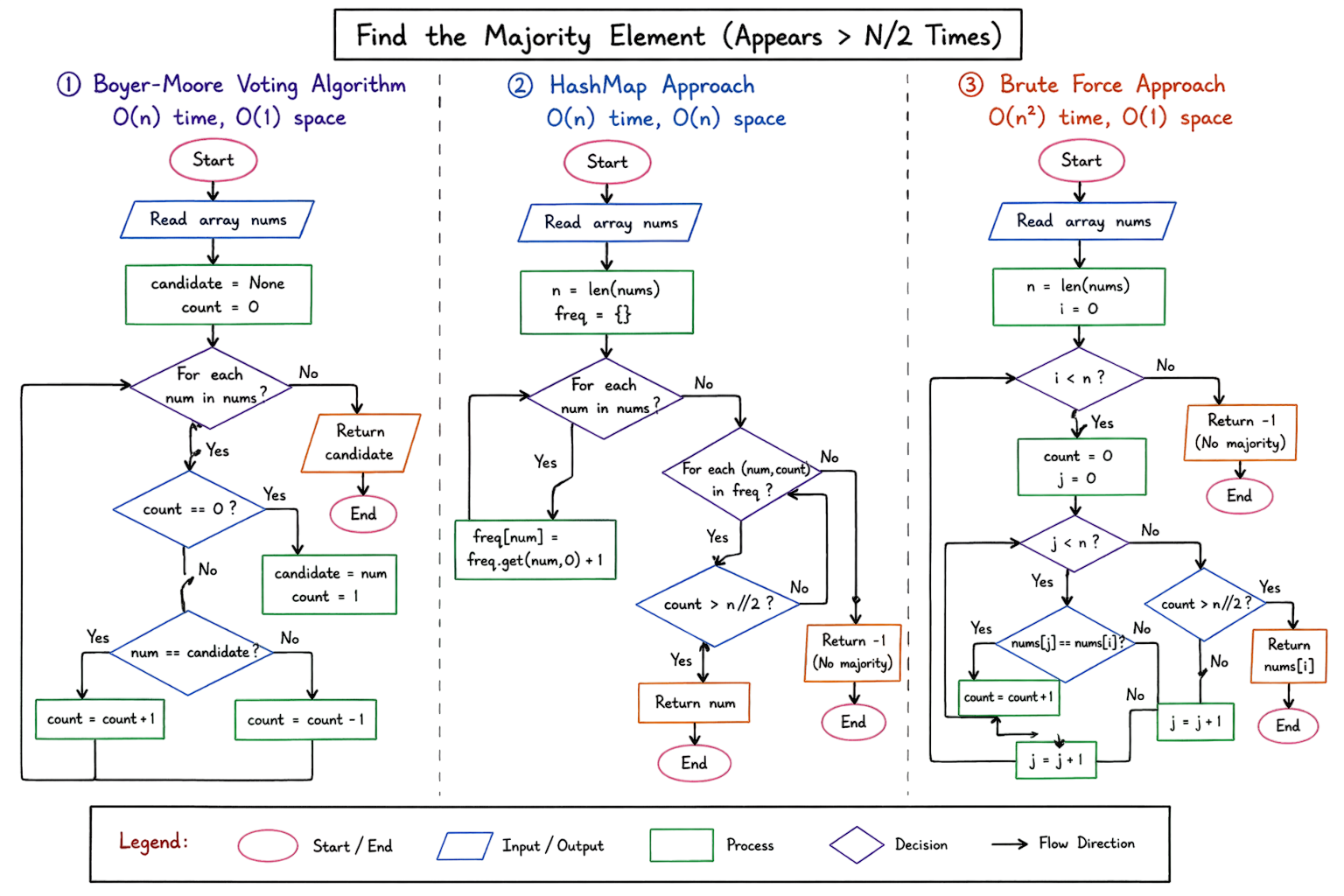
This is the clever one. The key insight is: if you pair up every occurrence of the majority element with a different element and cancel them out, you’ll always have the majority element left over.
Here’s how it works step by step:
- Start with
candidate = Noneandcount = 0 - For each element in the array:
- If
count == 0, set this element as the new candidate - If the element equals the candidate, increment count
- Otherwise, decrement count (they cancel each other)
- If
- At the end,
candidateholds the majority element
The majority element appears more than n/2 times. Even if every other element “cancels” one occurrence of it, the majority still has leftovers. It mathematically cannot be completely cancelled out.
# Boyer-Moore Voting Algorithm — O(n) time, O(1) space
def majority_boyer_moore(nums):
    candidate = None
    count = 0

    for num in nums:
        if count == 0:
            candidate = num  # New candidate selected
        if num == candidate:
            count += 1      # Same as candidate — support it
        else:
            count -= 1      # Different — cancel one vote

    return candidate
09: Flowchart
10: Pseudocode
FUNCTION findMajorityElement(nums):
    candidate ← NULL
    count ← 0

    FOR EACH num IN nums DO:
        IF count == 0 THEN:
            candidate ← num
        END IF
        IF num == candidate THEN:
            count ← count + 1
        ELSE:
            count ← count - 1
        END IF
    END FOR

    RETURN candidate
END FUNCTION
11: Full Python Program — All 3 Methods
# ── METHOD 1: Brute Force — O(n²) Time, O(1) Space ──
def majority_brute(nums):
    n = len(nums)
    for i in range(n):
        count = 0
        for j in range(n):
            if nums[j] == nums[i]:
                count += 1
        if count > n // 2:
            return nums[i]
    return -1

# ── METHOD 2: HashMap — O(n) Time, O(n) Space ──
def majority_hashmap(nums):
    n = len(nums)
    freq = {}
    for num in nums:
        freq[num] = freq.get(num, 0) + 1
    for num, count in freq.items():
        if count > n // 2:
            return num
    return -1

# ── METHOD 3: Boyer-Moore — O(n) Time, O(1) Space ──
def majority_boyer_moore(nums):
    candidate = None
    count = 0
    for num in nums:
        if count == 0:
            candidate = num
        count += 1 if num == candidate else -1
    return candidate

# ── MAIN — User Input ──
if __name__ == "__main__":
    n = int(input("Enter array size: "))
    nums = list(map(int, input("Enter elements: ").split()))

    print("\n── Results ──")
    print(f"Brute Force    : {majority_brute(nums)}")
    print(f"HashMap        : {majority_hashmap(nums)}")
    print(f"Boyer-Moore    : {majority_boyer_moore(nums)}")
12: Dry Run — Step by Step
Let’s trace through nums = [2, 2, 1, 1, 1, 2, 2] using Boyer-Moore.
| Step | Current Num | Count Before | Action | Candidate | Count After |
|---|---|---|---|---|---|
| 1 | 2 | 0 | count=0 → candidate=2, count+1 | 2 | 1 |
| 2 | 2 | 1 | num==candidate → count+1 | 2 | 2 |
| 3 | 1 | 2 | num≠candidate → count-1 | 2 | 1 |
| 4 | 1 | 1 | num≠candidate → count-1 | 2 | 0 |
| 5 | 1 | 0 | count=0 → candidate=1, count+1 | 1 | 1 |
| 6 | 2 | 1 | num≠candidate → count-1 | 1 | 0 |
| 7 | 2 | 0 | count=0 → candidate=2, count+1 | 2 | 1 |
✓
13: Time & Space Complexity
| Approach | Time Complexity | Space Complexity | Verdict |
|---|---|---|---|
| Brute Force | O(n²) | O(1) | Too slow for large inputs |
| HashMap | O(n) | O(n) | Fast but uses extra space |
| Boyer-Moore | O(n) | O(1) | ✅ Best — use this in interviews |
14: Test Cases
15: Edge Cases to Watch Out For
- Single element array: Always the majority. Count becomes 1 immediately.
- All same elements: Candidate never changes. Count keeps increasing.
- No majority exists: Boyer-Moore still returns a candidate — but it could be wrong. Always verify with a second pass if the majority is NOT guaranteed.
- Negative numbers: The algorithm handles them perfectly since it only checks equality, not magnitude.
- Even-length arrays: Majority needs to appear strictly more than n/2 times, not just n/2.
16: Common Interview Questions
Q1. What is the majority element?
An element that appears more than n/2 times in an array of size n. It’s also called the dominant element or the absolute majority.
Q2. Can there be more than one majority element?
No. If one element appears more than n/2 times, there can’t be another doing the same — they’d together exceed n elements, which is impossible.
Q3. Does Boyer-Moore work if no majority exists?
It returns a candidate, but that candidate might not be the majority. If the majority is not guaranteed, add a second pass to verify the count exceeds n/2.
Q4. What if we need elements appearing more than n/3 times?
You can extend Boyer-Moore to track two candidates and two counts simultaneously. This is LeetCode 229 — Majority Element II.
Q5. Is sorting the array a valid approach?
Yes — after sorting, the middle element nums[n//2] is always the majority. But this takes O(n log n) time, which is worse than Boyer-Moore’s O(n).
17: Real World Applications
Find which candidate got the absolute majority of votes in an election — same exact logic.
Identify the dominant opinion in a survey response dataset without storing all responses in memory.
In real-time data streams, find the most frequent value without storing the entire stream — Boyer-Moore handles this in O(1) space.
18: Mistakes Beginners Make
- Forgetting to check count == 0 before updating: You must reset the candidate when count drops to zero, not after.
- Using >= instead of >: Majority means strictly more than n/2, not equal to n/2.
- Using integer division wrong:
n // 2is correct — don’t forget the floor division. - Assuming Boyer-Moore always works without verification: If majority is not guaranteed, you need a second pass to confirm.
- Not handling empty arrays: Always add a guard check if the input might be empty.
Conclusion
The majority element problem is a classic that every developer preparing for coding interviews should have in their toolkit. The progression from brute force → hashmap → Boyer-Moore teaches a valuable lesson: sometimes, a clever observation (the majority can’t be cancelled out) leads to a dramatically better solution.
Boyer-Moore Voting Algorithm is elegant because it does something most people wouldn’t expect: it solves a frequency problem without counting frequencies. If you understand why it works — not just how — you’ll be able to adapt it to related problems instantly.
Always lead with Boyer-Moore in your interview. If the interviewer asks you to not assume a majority exists, describe the two-pass verification. If they ask about n/3 majority, extend to two candidates.
FAQ
Counter(nums).most_common(1)[0][0] works, but it uses O(n) space. Interviewers often want you to implement the O(1) space solution using Boyer-Moore.
pro.technaga.com
if you want more follow
if you more on programming follow
if you want to see this in a good stylish way click this Find Majority Element in Array