Introduction
📋 Problem Statement
Given an array of integers (which can include negatives), find the contiguous subarray with the largest subarrays sum and return that sum.
Example 1
Input: [-2, 1, -3, 4, -1, 2, 1, -5, 4]
Output: 6
Reason: Subarray [4, -1, 2, 1] has the max subarrays sum = 6
Example 2
Input: [1, 2, 3, 4, 5]
Output: 15
Reason: All positive — total subarrays sum = 15 (take full array)
📥 Input / Output Format & Constraints
- First line: integer
n(size of array) - Second line:
nspace-separated integers
- Print the maximum subarrays sum (single integer)
🐢 Naive Approach (Brute Force)
The simplest idea: try every possible subarray, compute its subarrays sum, track the maximum. Two common brute-force versions exist:
- O(n³) approach — Three nested loops: pick start, pick end, loop to sum
- O(n²) approach — Two loops: pick start, extend end while accumulating subarrays sum
# O(n²) brute force — computes subarrays sum for every pair
def max_subarray_brute(arr):
    n = len(arr)
    max_sum = arr[0]
    for i in range(n):
        curr = 0
        for j in range(i, n):
            curr += arr[j]
            max_sum = max(max_sum, curr)
    return max_sum
⚡ Optimal Approach – Kadane’s Algorithm
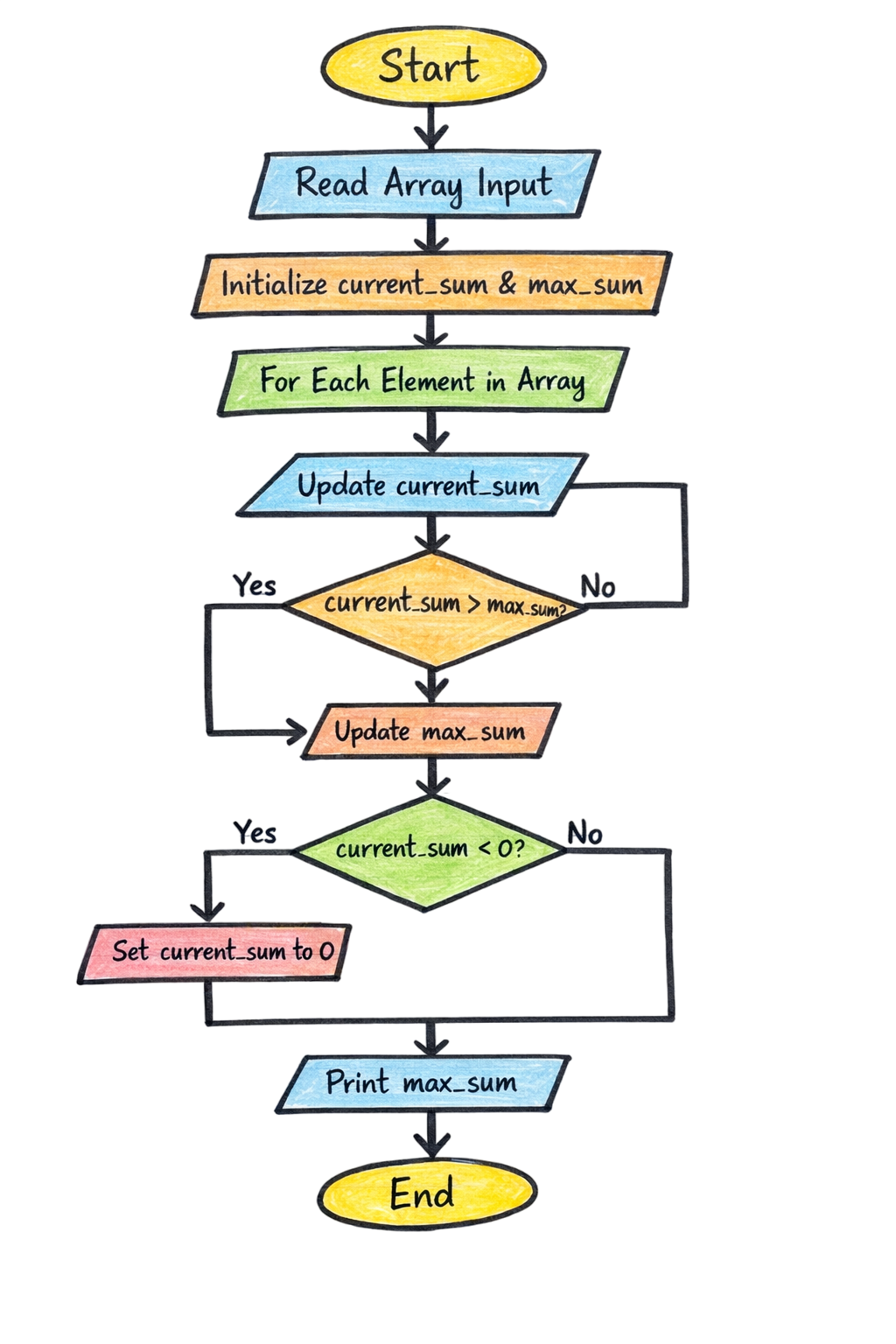
Kadane’s Algorithm computes the maximum subarrays sum in a single pass using one brilliant observation:
Only 2 variables are needed:
- current_sum — the best subarrays sum ending at the current index
- max_sum — the best subarrays sum seen anywhere in the array so far
At each step: current_sum = max(arr[i], current_sum + arr[i]). If the running subarrays sum is less than starting fresh, we restart. Then update max_sum if needed.
🔀 Algorithm Flowchart
📝 Pseudocode
FUNCTION kadane(arr):
    // Initialize both values to arr[0] for all-negative support
    current_sum ← arr[0]
    max_sum     ← arr[0]      // tracks best subarrays sum so far

    FOR i FROM 1 TO length(arr) - 1:
        current_sum ← MAX(arr[i], current_sum + arr[i])
        max_sum     ← MAX(max_sum, current_sum)

    RETURN max_sum             // maximum subarrays sum
🐍 Python Program
def kadane(arr):
    # Initialize to arr[0] — handles all-negative arrays correctly
    current_sum = arr[0]
    max_sum     = arr[0]   # best subarrays sum found so far

    for i in range(1, len(arr)):
        # Extend current subarray OR start a new one from arr[i]
        current_sum = max(arr[i], current_sum + arr[i])

        # Update maximum subarrays sum if we found a better one
        max_sum = max(max_sum, current_sum)

    return max_sum   # final answer: maximum subarrays sum


n   = int(input("Enter size of array: "))
arr = list(map(int, input("Enter elements: ").split()))

result = kadane(arr)
print("Maximum Subarrays Sum:", result)
🔍 Dry Run — Step by Step
Input: [-2, 1, -3, 4, -1, 2, 1, -5, 4]
Initial: current_sum = –2, max_sum = –2 (subarrays sum starts at first element)
| Step | Element | curr + elem | current_sum | max_sum (subarrays sum) |
|---|---|---|---|---|
| 1 | 1 | –2+1 = –1 | 1 | 1 |
| 2 | –3 | 1+(–3) = –2 | –2 | 1 |
| 3 | 4 | –2+4 = 2 | 4 | 4 |
| 4 | –1 | 4+(–1) = 3 | 3 | 4 |
| 5 | 2 | 3+2 = 5 | 5 | 5 |
| 6 | 1 | 5+1 = 6 | 6 | 6 ✓ |
| 7 | –5 | 6+(–5) = 1 | 1 | 6 |
| 8 | 4 | 1+4 = 5 | 5 | 6 |
💡 Code Explanation
- current_sum = arr[0] — Start at the first element. Initializing to 0 would break all-negative subarrays sum cases.
- max_sum = arr[0] — Tracks the overall best subarrays sum across the entire array.
- max(arr[i], current_sum + arr[i]) — The core of Kadane’s: restart vs extend. If the current subarrays sum running total is dragging you down, cut it.
- max(max_sum, current_sum) — After each step, update the global maximum subarrays sum if needed.
- return max_sum — The final maximum subarrays sum after processing all elements.
📊 Time & Space Complexity
Time Complexity
One pass through the array. Each element’s contribution to the subarrays sum is evaluated exactly once — no nested loops.
Space Complexity
Only two variables used (current_sum, max_sum) regardless of input size. No extra arrays needed to track subarrays sum.
🧪 Test Cases
01
[-2, 1, -3, 4, -1, 2, 1, -5, 4]
→ 6
02
[1, 2, 3, 4, 5]
→ 15
03
[-3, -1, -4, -2]
→ -1
04
[7]
→ 7
05
[0, -1, 2, 0, 3, -2]
→ 5
06
[-5, -3, 100, -2, -1]
→ 100
⚠️ Edge Cases to Watch
- All negatives: Don’t initialize max_sum to 0 — the subarrays sum answer would be wrong. Start with arr[0].
- Single element: The loop never runs; subarrays sum = arr[0]. Works correctly.
- Array with only zeros: Maximum subarrays sum = 0. The algorithm handles it cleanly.
- Very large values: Python handles arbitrarily large integers — no overflow when computing subarrays sum.
🧠 Why Kadane’s Algorithm Works
Think of the subarrays sum like a stock portfolio. Each array element is a daily gain or loss. If your running total (subarrays sum so far) is negative, carrying it forward can only hurt you — so you cut losses and restart fresh.
Formally, Kadane’s computes the maximum subarrays sum ending at each index using this DP recurrence:
dp[i] = max(arr[i], dp[i-1] + arr[i])
Kadane’s is this DP recurrence optimized to O(1) space — no dp array stored, just two variables tracking the subarrays sum.
🎯 Common Interview Questions on Subarrays Sum
🌍 Real World Applications of Subarrays Sum
Stock Profit Analysis
Maximum subarrays sum of daily gains/losses reveals the best buy-sell window.
Temperature Streaks
Find the continuous period with the highest subarrays sum of temperature rise.
Signal Processing
Detect the strongest subarrays sum burst in a time-series of signal amplitudes.
Game Scoring
Best consecutive subarrays sum scoring run for a player across match timeline.
🚫 Mistakes Beginners Make with Subarrays Sum
max(arr[i], current_sum + arr[i]) means negative subarrays sum values are never discarded.🏁 Conclusion
Kadane’s Algorithm is the definitive solution for the maximum subarrays sum problem. It’s elegant, fast, and once you understand the core insight — if the subarrays sum so far hurts you, let it go — you’ll never forget it.
This problem appears constantly in technical interviews, and explaining it confidently with a dry run, complexity analysis, and edge cases puts you miles ahead of other candidates.
Want to level up further? Try these related subarrays sum challenges:
- Return the actual subarray that gives the maximum subarrays sum
- Maximum subarray product (a twist on the subarrays sum idea)
- Maximum circular subarrays sum
❓ Frequently Asked Questions – Subarrays Sum & Kadane’s Algorithm
🎯 Featured Snippet – Quick Answer
What is the maximum subarrays sum problem?
Maximum subarrays sum is the largest sum of any contiguous subarray in a given array. Kadane’s Algorithm solves it in O(n) time by maintaining a running sum that resets when negative, updating the global maximum at each step.