01: Introduction
The catch? You cannot use division. That single constraint is what makes this go from trivial to genuinely tricky. Most people’s first instinct is to multiply everything together and then divide by each element. Makes sense, right? But the moment there is a zero in the array, that whole approach falls apart.
If you have ever stared at this problem and felt stuck, this guide will walk you through every single step — from the brute force approach all the way to the space-optimized O(n) solution — with zero confusion.
02: Problem Statement
Array Product Without Division
"The product of array except self problem gives you an integer arraynums of length n, return an array output such that:output[i] = product of all elements in nums except nums[i]
Constraints:
- 2 ≤ nums.length ≤ 10⁵
- -30 ≤ nums[i] ≤ 30
- You must NOT use the division operator
- Algorithm must run in O(n) time
- The result is guaranteed to fit in a 32-bit integer
Examples
Example 1 — Normal Input
Input : [1, 2, 3, 4]
Output: [24, 12, 8, 6]

Why?
index 0 → 2×3×4 = 24
index 1 → 1×3×4 = 12
index 2 → 1×2×4 = 8
index 3 → 1×2×3 = 6
Example 2 — Zero in Array (Tricky!)
Input : [1, 2, 0, 4]
Output: [0, 0, 8, 0]

Why?
index 0 → 2×0×4 = 0
index 1 → 1×0×4 = 0
index 2 → 1×2×4 = 8  ← only position that skips the zero
index 3 → 1×2×0 = 0
03: Why This Problem Is Important
The product of array except self isn’t just a puzzle — it teaches a mental model that appears everywhere in competitive programming and system design interviews.
📌 Key Reasons It’s Asked in FAANG Interviews
- Tests your ability to think about prefix/suffix decomposition — a recurring pattern in problems like Maximum Subarray Product, Rain Water Trapping, and Jump Game II.
- Verifies that you can solve a problem without relying on division, which forces creative thinking.
- Checks your understanding of edge cases — especially zero handling — which separates good candidates from great ones.
- Validates that you can write clean O(n) solutions under time pressure.
04: Naive Approach — O(n²)
The brute force solution is simple: for each index, loop through the entire array and multiply everything except the current element.
The brute force approach to product of array except self is simple.
def product_except_self_brute(nums):
    n = len(nums)
    output = [1] * n

    for i in range(n):
        product = 1
        for j in range(n):
            if i != j:
                product *= nums[j]
        output[i] = product

    return output
05: Division Approach — Why It’s Wrong
The “smart” beginner approach: multiply all elements together, then divide by each element to get the product of the rest.
The division-based approach to product of array except self looks smart
# This looks smart — but it's forbidden AND broken
def product_with_division(nums):
    total = 1
    for x in nums:
        total *= x

    # What if nums = [1, 2, 0, 4] → total = 0
    # output[2] = 0 / 0  →  ZeroDivisionError 💥
    return [total // x for x in nums]
06: Optimal Approach — Prefix + Suffix Product
Key Intuition
For any index i, the product of everything except itself is equal to:
output[i] = (product of all elements to the LEFT of i) × (product of all elements to the RIGHT of i)
So we precompute two arrays — left products and right products — then multiply them together. No division needed, ever.
def product_except_self(nums):
    n = len(nums)

    # Step 1: Build left product array
    # left[i] = product of all elements to the LEFT of index i
    left = [1] * n
    for i in range(1, n):
        left[i] = left[i - 1] * nums[i - 1]

    # Step 2: Build right product array
    # right[i] = product of all elements to the RIGHT of index i
    right = [1] * n
    for i in range(n - 2, -1, -1):
        right[i] = right[i + 1] * nums[i + 1]

    # Step 3: Multiply left and right at each index
    output = [left[i] * right[i] for i in range(n)]
    return output
07: Space Optimized — O(1) Extra Space
Instead of storing two separate arrays, we use the output array itself for left products, then do a reverse pass using a running suffix variable.The space-optimized version of product of array except self uses the output array itself.
def product_except_self_optimized(nums):
    n = len(nums)
    output = [1] * n

    # Forward pass: store left products in output
    prefix = 1
    for i in range(n):
        output[i] = prefix
        prefix *= nums[i]

    # Backward pass: multiply with running suffix product
    suffix = 1
    for i in range(n - 1, -1, -1):
        output[i] *= suffix
        suffix *= nums[i]

    return output

# ──── Main (with user input) ────
if __name__ == "__main__":
    nums = list(map(int, input("Enter array elements: ").split()))
    result = product_except_self_optimized(nums)
    print("Output:", result)
08: Visualization — Prefix & Suffix Concept
For input [1, 2, 3, 4], here is exactly how the prefix and suffix products build up and combine:
Input array
Left products (all nums to left, 1 if none)
Right products (all nums to right, 1 if none)
Output = Left × Right
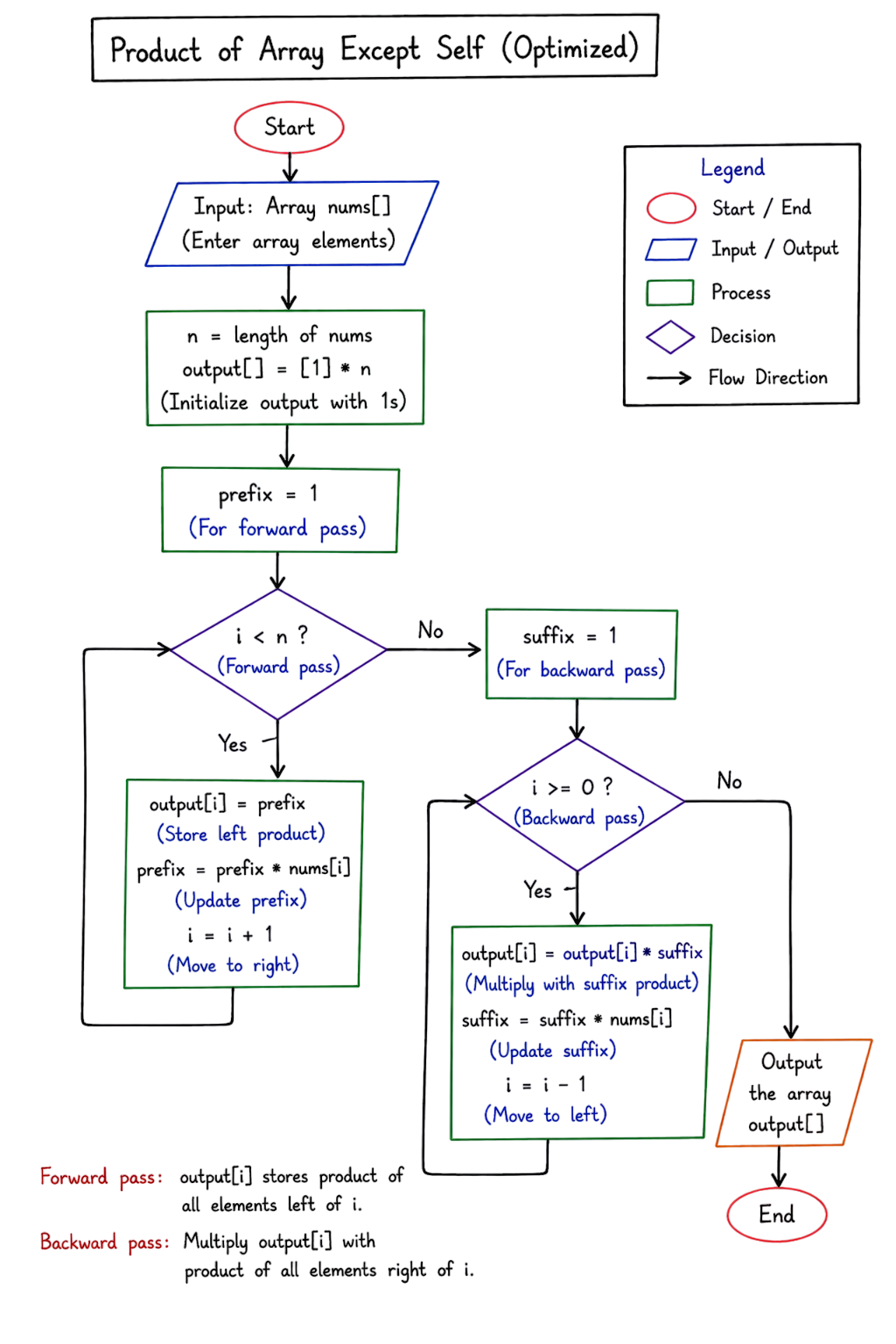
09: Flowchart
Here is the complete flowchart for the product of array except self algorithm.
10: Dry Run — Step by Step
Let’s dry run the product of array except self algorithm step by step
Input: [1, 2, 3, 4]
Forward Pass (building prefix)
| i | output[i] = prefix | prefix after update |
|---|---|---|
| 0 | 1 | 1 × 1 = 1 |
| 1 | 1 | 1 × 2 = 2 |
| 2 | 2 | 2 × 3 = 6 |
| 3 | 6 | 6 × 4 = 24 |
After forward pass: output = [1, 1, 2, 6]
Backward Pass (multiplying with suffix)
| i | output[i] × suffix | suffix after update |
|---|---|---|
| 3 | 6 × 1 = 6 | 1 × 4 = 4 |
| 2 | 2 × 4 = 8 | 4 × 3 = 12 |
| 1 | 1 × 12 = 12 | 12 × 2 = 24 |
| 0 | 1 × 24 = 24 | 24 × 1 = 24 |
Final output: [24, 12, 8, 6] ✅
10: Time & Space Complexity
| Method | Time | Space (Extra) |
|---|---|---|
| Brute Force (nested loops) | O(n²) | O(1) |
| Division Trick | O(n) | O(1) — but invalid |
| Prefix + Suffix Arrays | O(n) | O(n) |
| Space Optimized (Recommended) | O(n) | O(1) |
11: Test Cases
Here are 6 test cases to verify your product of array except self solution
12: Edge Cases Deep Dive
Case 1: One Zero
When exactly one zero exists, only the position of that zero gets a non-zero output. Every other position gets 0 because zero appears in their product. The zero position skips itself and gets the product of all other elements.
Case 2: Two or More Zeros
When two or more zeros exist, every product will include at least one zero (since skipping one zero still leaves another). So the entire output array becomes all zeros.
Case 3: All Ones
When the array is [1, 1, 1, 1], the product of all elements except any single 1 is always 1. Output is all ones. Simple, but good to verify your code handles it correctly.
Case 4: Negative Numbers
The algorithm works identically with negatives. Prefix and suffix products track sign changes naturally. No special handling needed.
13: Common Mistakes Beginners Make
These are the most common mistakes when solving product of array except self
[5], there are no other elements so the product is 1 by definition. Make sure your loop bounds handle n=1.
14: Real-World Applications
The product of array except self pattern appears in several real-world systems..
📡 Signal Processing
In digital signal processing, computing the product of all frequencies except the current one is used in certain filter designs and spectral analysis pipelines.
📊 Multiplicative Models in Statistics
Leave-one-out product computations appear in Bayesian probability models where you calculate the likelihood contribution of every observation except one.
🔀 Data Pipelines
In ETL pipelines and feature engineering, calculating multiplicative contributions without including self-values is used for normalization and relative weighting.
15: Frequently Asked Questions
Conclusion
The Product of Array Except Self problem is a perfect example of how a constraint — no division — transforms a seemingly trivial task into something that teaches you a powerful algorithmic pattern.
The key insight is splitting the contribution of each index into two parts: everything on its left, and everything on its right. Build those products in two passes, multiply them together, and you’re done in O(n) time with O(1) extra space.
pro.technaga.com
If you want more, follow
If you are more into programming, follow
If you want to see this in a good, stylish way, click this product-array-except-self